ADHD Communication Problems: Why Small Conversations Turn Into Big Arguments
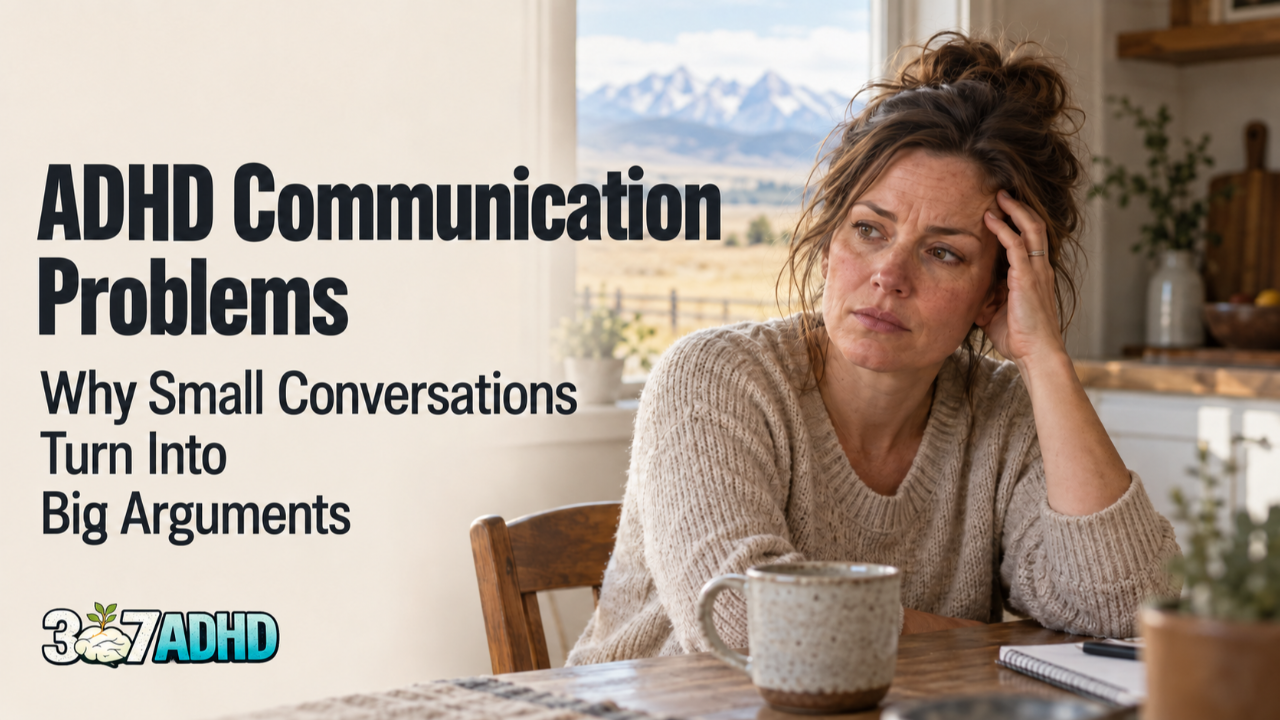
ADHD Communication Problems Can Start With Something Small
“Did you remember to buy bread?”
It sounds like a simple question. But ten minutes later, you’re arguing about who does more, who never listens, and something that happened three years ago.
One person feels criticized. The other feels dismissed. Both are explaining why they’re upset, and the original question has disappeared.
Rather Watch? Click the video below to see the video
ADHD communication problems can involve much more than interrupting or losing track of a conversation. Emotional reactions, inconsistent follow-through, accumulated frustration, and the meaning each person attaches to a comment can all influence what happens next.
Research links adult ADHD with increased relationship conflict and distress. That does not mean every ADHD relationship is high conflict or that conflict is inevitable. It means these patterns deserve attention before they become the way you relate to each other.
Repeated Letdowns Can Deepen ADHD Communication Problems
Sometimes a conversation about bread really is about bread.
Sometimes it is about being the person who remembers everything, checks whether it happened, and rearranges the evening when it didn’t.
ADHD can make remembering commitments, getting started, managing time, and following through consistently more difficult and those difficulties can create real work for someone else.
The person with ADHD may be thinking, “I forgot one thing. Why is this such a big deal?”
Their partner may be thinking, “This is the fifth thing this week, and I’m exhausted from keeping track.”
Over time, the conversation becomes emotionally loaded. One person feels constantly corrected. The other feels constantly responsible.
Forgetting does not prove you don’t care. But caring does not erase the impact of repeatedly forgetting.
Understanding ADHD matters. So does developing skills and supports that reduce how often another person has to absorb the consequences. A shared calendar, a reliable reminder system, or clearly defined ownership of a task can make caring more visible through action.
Why ADHD Emotions Can Escalate a Conversation
Emotional regulation is another important piece: managing what you do when frustration, embarrassment, disappointment, or hurt shows up.
For some people with ADHD, an emotional response can arrive quickly and feel difficult to slow down. You might respond sharply, interrupt because your explanation feels urgent, or become too overwhelmed to listen.
A question about groceries becomes a threat to defend against.
Your partner’s response may become sharper, too. Now you are reacting to their tone, they are reacting to yours, and neither person feels heard.
Rejection sensitivity can add another layer. There is a difference between hearing “You forgot the bread” and hearing “You’re unreliable. You always disappoint me.”
The second message may never have been spoken, but it can still be the message someone takes away.
If you have a history of being corrected or feeling that you fall short, a present-day complaint may land on an already tender spot. You might overexplain, counterattack, or withdraw. Your partner may interpret that response as avoiding the issue.
A meta-analysis of 13 studies found greater emotion-regulation difficulties in adults with ADHD than in comparison groups. Rejection sensitivity is a related area of emerging research, although “rejection sensitive dysphoria” is not a formal diagnosis.
Your hurt deserves attention. So does checking whether the meaning you heard matches what the other person said.
Try asking: “Am I responding to their words, or to what I’m afraid those words mean?”
Communication Problems Aren’t Always About Sensitivity
We also need to leave room for another possibility: the other person really is being critical.
In my coaching practice, I often hear from women with ADHD who are intensely critical of themselves and who describe relationships with frequent criticism. That is an observation from my practice, rather than proof that women with ADHD are more likely to choose critical partners.
Still, it raises a worthwhile question: when criticism is familiar, does it become harder to recognize when it has gone too far?
There is a meaningful difference between:
“We agreed you would handle this, and it didn’t happen. I need us to make a different plan.”
And:
“You’re useless. I can never count on you for anything.”
The first addresses a problem. The second attacks the person.
ADHD can create repeated frustrations that genuinely need attention. Those frustrations do not make humiliation, contempt, or constant personal criticism acceptable.
Being sensitive to criticism does not mean the criticism is imagined, and having ADHD does not make you solely responsible for the conflict.
One person may need better supports for follow-through AND the other may need to change how they express frustration. Sometimes both are true.
When One Issue Becomes Every Issue
Another pattern I see in coaching is a conversation expanding until it becomes almost impossible to resolve.
One comment reminds you of a previous argument. That reminds you of another time you felt misunderstood. Suddenly, you are trying to explain the entire history so the other person understands why this moment matters.
Your partner adds their own examples.
Now the conversation includes groceries, money, parenting, last weekend, and whose family was more critical growing up.
Some people with ADHD recognize this experience of thoughts branching into related memories and concerns. Either partner, however, can widen an argument.
The older concerns may be valid, but trying to resolve all of them at once can leave you going around in circles.
Separate two questions:
What needs to be resolved right now?
What larger pattern needs its own conversation?
You can replace the missing bread today and make time to address the unequal workload tomorrow. Keeping the immediate conversation focused does not require dismissing the bigger issue.
When Conflict Becomes Stimulating
Have you noticed that you feel more engaged once a conversation becomes heated? Suddenly, your attention is locked in, you have plenty to say, and stopping feels difficult—even when the conversation is going nowhere.
For some people, the intensity of an argument can feel activating.
You may have heard this described as “arguing for dopamine.” However, research on dopamine and ADHD is more complicated than a simple dopamine deficiency. It does not establish that people with ADHD use arguments to chemically self-medicate.
But also...you don't need to identify the brain chemicals involved to notice a costly pattern.
Maybe you keep pushing after your partner asks for a break. Maybe you introduce another controversial point just as the conversation starts settling down. Maybe proving your point becomes more compelling than reaching understanding.
Ask yourself:
- Am I trying to resolve the issue or keep the exchange going?
- Has my partner answered me, but I’m still looking for something to challenge?
- Do I feel energized while the other person is becoming exhausted?
- What am I trying to accomplish with my next sentence?
If you recognize this pattern, experiment with another source of engagement: movement, music, a hands-on activity, or a mutually enjoyable challenge. Difficult conversations might also go better while walking together, if that works for both people.
The concern still needs attention. But letting the discussion escalate into a huge unresolvable tornado of relationship issues isn't useful.
Feeling more engaged in an argument does not mean the argument is helping.
Why Changes After a Big Fight May Fade
Another pattern I see in coaching is that relationship concerns receive focused attention once they become urgent.
A partner reaches a breaking point. There is a serious conversation. Promises are made, and things improve for a while.
Then everyday life takes over, and the old pattern returns.
That does not necessarily mean the promise was dishonest. A sincere intention can still lack the structure needed to become consistent action.
“I’ll do better” leaves a lot unanswered.
What will you do differently? What will remind you? What support do you need? How will you notice whether the plan is working?
The person making the change needs to own it. That does not mean doing it alone. Treatment, therapy, coaching, external reminders, and shared agreements can support their effort.
But your relationship needs a plan that continues working after the urgency fades.
How to Keep Small Conversations Manageable
These are practical experiments to try, rather than expectations to handle every conversation perfectly.
Name the issue clearly.
“I want us to figure out how groceries get remembered.”
Check your interpretation.
“When you said that, I heard that you think I don’t care. Is that what you meant?”
Acknowledge the impact before explaining.
“I forgot, and that left you with another trip.”
Pause with a return time.
“I’m getting too worked up to listen well. Can we take a break and come back at 7:30?” Agree on a realistic time, then return.
Give larger concerns somewhere to go.
Write down related issues and arrange a separate conversation. Follow through so they do not disappear.
Replace a promise with an observable next step.
Decide who owns the task, what cue they will use, and how they will check whether the plan worked.
Research exploring adults’ experiences of ADHD relationships describes misunderstood intentions, emotional strain, and imbalances in responsibility. These lived experiences help show why improving communication also involves changing what happens between conversations.
Give Your Relationship Attention Before It Becomes an Emergency
Recurring conflict deserves attention even when nobody is threatening to leave.
You can care deeply about someone and still have patterns that hurt them. You can have ADHD-related difficulties and take responsibility for building supports. You can work on your reactions while expecting respectful treatment from others.
Start with one conversation that keeps repeating.
What happens on the surface? What is driving the pattern underneath? What could you change next time?
That is the work of Surface → Source → Shift™: understanding the pattern well enough to take a useful next step.
If you are tired of having the same arguments and want support putting changes into practice, book a discovery call. We can explore what is happening and whether coaching fits the changes you want to make.
 About Rebecca Kuhbacher
Rebecca Kuhbacher, M.Ed., is an ADHD and Executive Function Coach, former National Board Certified Teacher, and founder of 307 ADHD. Through her professional coaching practice and personal experience as a mother of four in an ADHD household, she brings a practical perspective to communication, emotional regulation, and shared responsibility. Her work supports adults and families in understanding recurring patterns and putting meaningful changes into practice.
FAQ's ADHD Communication Problems
1. How does ADHD affect communication in adults?
ADHD can make it harder to stay focused, hold information in mind, pause before responding, and manage emotions during a conversation. You might miss a detail, interrupt, or react before checking what someone meant. Start by noticing where communication breaks down for you. Then choose one support for that specific difficulty, rather than trying to change everything at once.
2. What are common ADHD communication problems in relationships?
Common challenges include interrupting, missing details, forgetting agreements, becoming defensive, and bringing several related issues into one conversation. Over time, one person may feel constantly corrected while the other feels responsible for remembering everything. Look beneath the argument: is the problem attention, an unclear agreement, an unreliable system, or accumulated frustration? Different sources need different solutions.
3. Why do people with ADHD interrupt or talk too much?
Sometimes a thought feels urgent, or you worry you’ll forget it if you don’t say it immediately. That can explain an interruption, but the other person still needs room to finish. Try jotting down a keyword to hold your thought, then return your attention to them. If you interrupt, a simple “I jumped in—finish what you were saying” helps you practice a different response.
4. Why do people with ADHD lose focus during conversations?
Distractions, competing thoughts, and long explanations can make it difficult to follow a conversation. Choose a time when you have the attention to give, put your phone away, and reduce background noise. If you miss something, say so instead of guessing. “I lost the last part. Can you repeat it?” is more useful than agreeing to something you didn’t fully hear.
5. Why do people with ADHD go off-topic when talking?
One thought can bring up another memory, example, or concern. Before you know it, the conversation has branched into several directions. Those connections may matter, but they do not all need to be addressed at once. Write down the related concerns and ask, “What are we trying to resolve right now?” Give the bigger issues their own conversation.
6. Why does my ADHD partner get defensive about criticism?
A complaint may land as a much bigger message: “You forgot” becomes “You always disappoint me.” Strong emotions and previous experiences of criticism can contribute to defensiveness. Try checking the meaning before responding: “I heard that you think I don’t care. Is that what you meant?” Also pay attention to the delivery. A specific concern deserves discussion; personal attacks deserve a boundary.
7. Why do small conversations turn into big arguments with ADHD?
A small issue can land on accumulated disappointment, trigger a strong reaction, and pull older conflicts into the conversation. Suddenly, both people are defending themselves instead of solving anything. Separate the immediate issue from the larger pattern. If you are too worked up to listen, take a break with an agreed return time. Then come back to one clear problem.
8. Can ADHD make you forget conversations and commitments?
Yes. Attention and memory difficulties can make it harder to retain details or remember an agreement later. Forgetting does not prove you don’t care, but it can still leave someone else with extra work. Record the commitment while you are discussing it, choose a reminder, and clarify who owns the task. Build a system that supports follow-through without requiring your partner to keep reminding you.
9. How can adults with ADHD improve listening and reduce interruptions?
Make the conversation easier to follow: reduce distractions, let the speaker finish, and repeat back the main point before responding. Keep a place to jot down thoughts so you don’t have to say each one immediately. Pick one strategy and test it in a real conversation. Afterward, notice what helped and where you lost track. Use that information to adjust.
10. How do you communicate effectively with someone who has ADHD?
Be specific about the concern and the next step you need. “Can you put the appointment in your calendar now?” gives more direction than “You need to be more responsible.” Ask them to help choose a workable support and take ownership of using it. You can be understanding while expecting follow-through—and both people can express frustration without attacking each other.
Hey!