ADHD Family Support: Stop Trying to Change the Child Without Changing the System
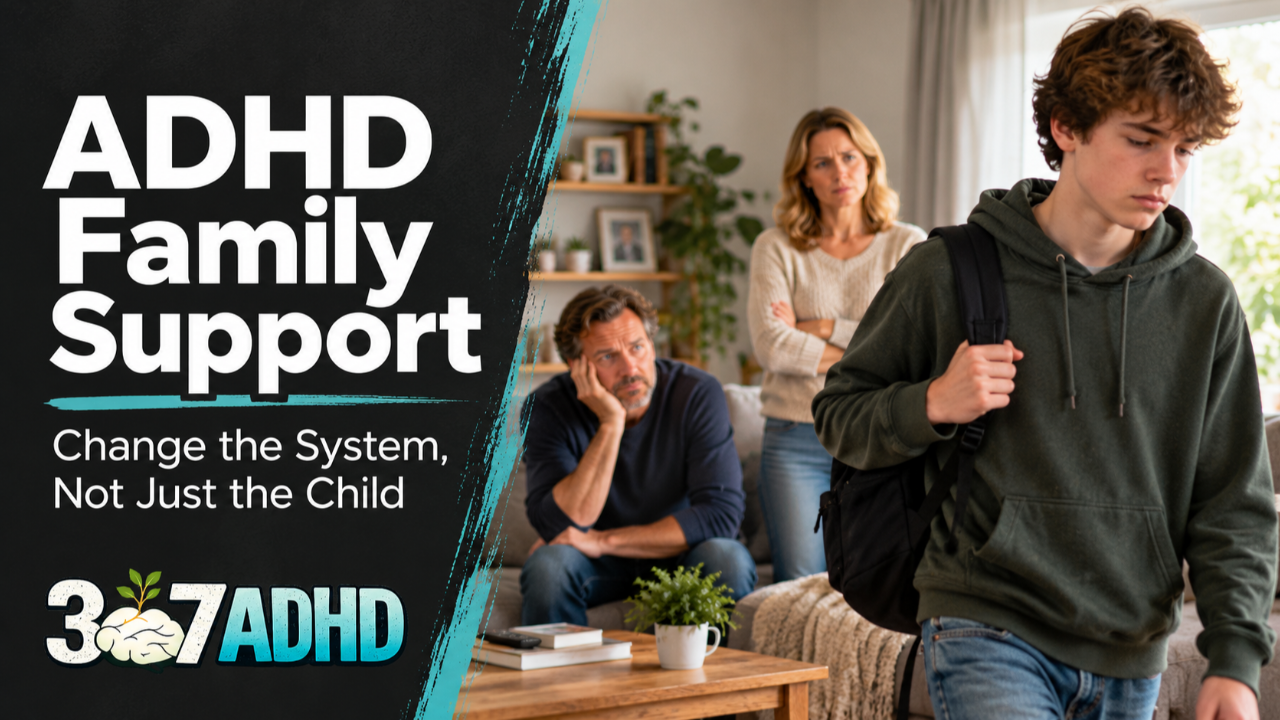
“Stop jumping on that.”
“You forgot your backpack again.”
“I already told you three times.”
“Why aren’t you ready?”
When you’re parenting a child with ADHD, you can get to the end of the day and realize that a lot of your conversations sounded like this.
You were trying to get everyone out the door. Keep someone from getting hurt. Help your child finish something they needed to do. You weren’t planning to spend the day correcting them.
But from your child’s perspective, the day may have felt like a running list of everything they did wrong.
This can be especially noticeable when a child’s hyperactivity or impulsivity affects everyone around them. The interruptions, movement, noise, and big reactions draw attention. Pretty soon, that child becomes the person everyone is watching, reminding, and asking to change.
Children with ADHD need to build skills. They need boundaries, practice, and support taking responsibility for their actions. But those skills develop within an environment of relationships, routines, expectations, and daily interactions.
Effective ADHD family support means looking at that bigger picture and asking:
Are we creating conditions that support what we’re asking our child to do?
ADHD Family Support: When Helping Becomes Constant Correction
Executive function difficulties create plenty of opportunities for things to go sideways.
Your child forgets the directions. Starts something and gets distracted. Loses track of time. Reacts before thinking. Leaves a trail of belongings through the house.
As a parent, you step in. You remind, redirect, explain, and point out what still needs to happen.
Individually, those moments may seem small. Together, they can become a lot.
A child may begin to hear “You forgot again” as one more piece of evidence that they can’t do anything right. If they are particularly sensitive to perceived criticism or rejection, even a well-intentioned reminder can land harder than you expected.
That doesn’t mean every reminder is harmful or that we can never correct our children. It means we need to notice the overall pattern.
How much of our interaction is about what needs fixing? How often does our child get to experience us enjoying them? Are they beginning to see themselves as the person who always messes things up?
Research gives us a reason to pay attention. A 2016 study by Musser and colleagues found that persistently high parental criticism was associated with a more persistent pattern of hyperactivity in children with ADHD. This does not establish that criticism caused those symptoms or that parents caused their child’s ADHD. It does suggest that family interactions deserve attention alongside the child’s individual challenges. pubmed.ncbi.nlm.nih.gov
Parents can love their children deeply and still get caught in an exhausting cycle of correction. Recognizing that cycle gives us somewhere to start.
Make Growth a Shared Practice Through ADHD Family Support
Think about what we ask children to do after a difficult moment.
Reflect on their behavior. Admit what went wrong. Apologize. Try a different approach next time.
Those are valuable skills. Children also need to see what those skills look like in the adults around them.
“I’m sorry I yelled. I was frustrated, and I need to handle that differently.”
“I didn’t explain that clearly. Let me try again.”
“This routine keeps leaving all of us frustrated. We need to look at what isn’t working.”
These statements show a child how to take responsibility without turning a mistake into a judgment about who they are.
In my coaching work, I see how much it matters when adults participate in the changes. A child is being asked to practice something their parents are practicing too. Reflecting on behavior and making adjustments become things the whole family does.
You can apologize for yelling and still hold a boundary. You can acknowledge your part in a difficult interaction while helping your child take responsibility for theirs.
Taking ownership of your piece gives your child a model for owning theirs.
It can also make correction easier to receive. There is a different feeling when the message is “We all have things we’re working on” rather than another conversation about everything the child needs to change.
How Your Family’s Home Environment Can Support a Child With ADHD
A child’s home environment includes the rhythm of the day, the expectations they’re navigating, and what happens when they’re having a hard time.
The way they’re greeted when they come home. The way they’re sent off to school. How bedtime unfolds. Whether routines are predictable and belongings have familiar places. Whether there are built-in opportunities for movement and active play without getting in trouble—or needing a parent to direct every moment.
All of these are part of the environment your child is learning to function within.
Think about how much your own surroundings affect you. When things feel rushed, chaotic, or tense, it can be harder to think clearly, manage frustration, and follow through. It’s worth looking at what the daily experience feels like for your child, too.
Are there opportunities to meet their needs throughout the day? Do routines help them understand what comes next? Does the household make room for their energy, or do they spend much of the day being asked to contain it?
Research on behavioral parent training supports paying attention to what happens before a struggle. A 2022 meta-analysis by Dekkers and colleagues found that programs placing greater emphasis on preventive strategies—changing the conditions that come before behavior—were associated with better parental confidence and mental health outcomes. These findings don’t establish that any single environmental change causes improvement, but they reinforce the value of looking beyond how adults respond after something goes wrong. www.sciencedirect.com
The question is: Does the way our home functions support what we’re asking our child to do?
Looking at that honestly, without shame, can help us notice where daily life is asking more of a child than we realized—and where the family’s patterns could offer more support.
ADHD and Communication: How Your Family Can Offer Support
The emotional environment matters, too. How we speak, listen, and respond becomes part of what a child experiences throughout the day.
We can spend a lot of time asking a child to listen without examining how we communicate. Are our expectations clear? Do we give them time to process? Are we trying to have a teaching conversation when everyone is already overwhelmed?
Sometimes, frustration also changes the message. A conversation that starts with an unfinished task becomes a conversation about how the child “never listens” or “doesn’t care.”
The original problem gets buried under judgments that are much harder to work through.
We need to be able to address behavior while keeping the child’s identity out of it. Something went wrong. Something needs attention. That can be discussed without deciding what it says about who the child is.
Communication also includes listening to their experience. What felt confusing? What were they trying to do? What made the situation harder than we understood?
We can hear their perspective and still hold an expectation. Understanding what happened gives us more useful information for deciding what comes next.
And children need interactions that have nothing to do with improvement. They need opportunities to tell us something funny, share an interest, and spend time with us without a lesson attached.
Look at Expectations, Consequences, and Repair
Every family has patterns around what is expected and what happens when those expectations aren’t met.
Some are deliberate. Others develop because everyone is tired and trying to get through the day.
When a struggle keeps repeating, it’s worth examining those patterns. Are expectations understood? Are they realistic for the child’s current skills? Are adults responding in reasonably consistent ways? Does the child know how to make things right after a mistake?
Consequences are part of that picture, but so is what the child learns from them.
Does our response help them understand the impact of their actions? Is there an opportunity to repair harm? Are we helping them practice something they can use the next time?
Children need support taking responsibility and developing the skills to handle situations differently. Adults need room to reflect on whether their responses are helping that learning happen.
Repair matters on both sides. When family members can return to a difficult interaction, acknowledge their part, and reconnect, children get repeated opportunities to see how relationships recover after conflict.
Why I Include Parents When Coaching Teens and Preteens
This bigger picture is why I don’t coach children or teenagers unless I’m also coaching their parents.
That is a deliberate choice based on what I see in my work. Children practice skills within the routines, expectations, and relationships they return to every day. I want the adults to have support examining those patterns and making changes, while respecting the child’s voice and growing independence.
Research supports involving parents. A 2023 review of behavioral parent-training studies found that helping parents learn and practice strategies benefited both children and parents. Compared with families in control groups, children whose parents received training showed improvements in ADHD symptoms and behavior, while parents felt more capable, used more positive parenting approaches, and had better relationships with their children. These benefits were still evident at follow-up, which averaged about five months after the programs ended.
Those findings concern structured behavioral parent-training programs; and while they don’t directly test my coaching program, they do provide evidence that working with parents can make a meaningful difference for children and families.
This is why I include parents in the process. When we look together at the communication, expectations, and patterns surrounding a child’s struggles, we can find places to make daily life more workable. Parents get support putting changes into practice, and children get to build skills in a family that is learning alongside them.
Move From the Surface to What’s Underneath
In my work, I use Surface → Source → Shift™ to help families examine recurring struggles.
The surface is what everyone notices: the arguing, forgetting, interrupting, or difficulty following through.
The source is what we need to understand. That may include executive function demands, overwhelm, unclear expectations, communication patterns, or a routine that isn’t working for the people using it.
The shift comes from using that understanding to decide what needs to change, including what adults can do differently and what skills the child needs help practicing and then putting them into practice with intentional language, supports, strategies and consequences that teach decision making.
That process creates room for curiosity. Instead of reaching the same conclusion about the child every time something goes wrong, the family can gather information, make adjustments, and learn together.
It also leaves room for connection and fun. Family life needs moments when everyone can enjoy each other without monitoring progress or solving a problem.
Pull Back and Look at the Bigger Picture
When you’re looking at what your child is struggling with, pull back and look at the bigger picture. Are your environment, communication, routines, and habits supporting the skills you’re trying to help your child build? Or are some of those patterns contributing to what makes daily life hard?
Approach those questions with curiosity. You’re observing what happens, noticing where things get stuck, and looking for changes that could help. The more you can do that without blaming yourself or your child, the easier it becomes to see opportunities for support.
And include your child in that process. What helps them remember? What makes getting started easier? Where do they focus best? What helps when everything feels like too much?
As you make adjustments together, your child gets to learn what works for them—and practice making those adjustments themselves. Over time, that becomes a skill they can carry into school, work, relationships, and their own home: understanding what they need and shaping their surroundings to support it.
Looking for support for your ADHD Family? Reach out and book a call. We'll explore where you may be getting stuck and see what next steps might be helpful.
 About Rebecca Kuhbacher
Rebecca Kuhbacher, M.Ed., is an ADHD and Executive Function Coach, educator, and founder of 307 ADHD. A former teacher and department head—and mom of four in an ADHD household—she helps families look beneath recurring struggles, build practical skills, and strengthen connection. Her Surface → Source → Shift™ approach helps parents understand what’s getting in the way and make changes that support the whole family.
Frequently Asked Questions about ADHD Family Support
How can I support my child with ADHD at home?
Start by pulling back and looking at the bigger picture. Are your routines, expectations, communication, and home environment supporting what you’re asking your child to do? Notice where the same struggles keep happening, and get curious about what’s underneath them. Your child needs opportunities to build skills, and the family can make changes that support that learning. Include your child in figuring out what helps so they can begin to recognize what works for them.
What is parent training for ADHD, and how does it help?
Parent training teaches caregivers practical ways to support a child with ADHD, including clear communication, positive reinforcement, predictable expectations, and consistent responses. It gives parents tools to use in everyday situations. In my coaching, we also look at the patterns underneath recurring struggles and how the family can work together to change them. The goal is to help parents feel more capable while creating conditions where their child can learn and grow.
Can changing our parenting approach help our child with ADHD?
Yes. How we respond is one part of the environment our children navigate every day. We can notice when we’re caught in constant correction, examine our expectations, and take ownership when our responses make a situation harder. That doesn’t mean we caused our child’s ADHD. It means we have opportunities to offer more effective support. When children see adults reflecting, apologizing, and making changes, they get a model for doing those things themselves.
How do family routines help children with ADHD?
Predictable routines can reduce how much a child has to remember, organize, and figure out in the moment. But a routine is only useful if it works for the people using it. If the same part of the day keeps ending in conflict, look at what the routine is asking of everyone. Where does your child need more support? What feels rushed or unclear? Build and adjust routines together rather than treating difficulty following one as another failure.
How can I set clear boundaries without constantly correcting my child?
Get clear about the expectation, then look at what helps your child meet it. Repeated correction can tell a child what went wrong without helping them understand what to do differently. I use Surface → Source → Shift™ to look beneath the behavior, identify barriers, and decide what needs to change. Hold the boundary, help your child repair harm when needed, and make room to practice the skills involved. Also notice their effort and progress so your interactions include more than reminders.
How can I communicate better with my child who has ADHD?
Look at both the message and the moment. Is your expectation clear? Does your child have time to process it? Is everyone calm enough for a useful conversation? Address what happened without making it a judgment about who your child is. Listen to their perspective, too—you can understand their experience and still hold an expectation. And protect conversations that have nothing to do with fixing something. Connection needs space in everyday family life.
How can I work with my child’s school to get ADHD support?
Start by talking with your child. What feels hard at school? Where do they feel overwhelmed, confused, or unable to keep up? Their experience matters, even when their grades look fine. Share those concerns with the school and ask what teachers are noticing. If you suspect your child needs additional support, request an evaluation in writing. You don’t need to figure out the right accommodations or choose between an IEP and a 504 Plan before asking for help. The goal is to understand your child’s needs and work together to support them.
Does my child with ADHD need an IEP or a 504 Plan?
An ADHD diagnosis alone doesn’t determine which plan a child needs. The important questions are how ADHD affects their access to learning and whether they need accommodations, specialized instruction, or both. Good grades don’t necessarily tell the whole story—consider the effort, support, and emotional cost behind them. If you’re concerned, ask the school about an evaluation.
How can parents manage the stress of raising a child with ADHD?
Pay attention to what the family system is asking of you, too. Are you responsible for remembering, prompting, anticipating, and managing everything? Look at where expectations, responsibilities, or routines could change so the day requires less constant intervention. Make room for repair when you lose your patience, and get support when you need it. You’re learning alongside your child. Protecting moments of connection and fun matters for you as well as for them.
Where can I find ADHD support groups and resources for families?
CHADD, your child’s school, and local community organizations can be starting points for education and parent support. If you want help applying what you’re learning to your own family, that’s where my coaching comes in. We look beneath recurring struggles, explore how communication, routines, and expectations are working, and make changes that support both you and your child. Book a discovery call to talk about what your family needs.
Hey!