ADHD Toys: The Best Ones Do More Than Keep Your Child Busy
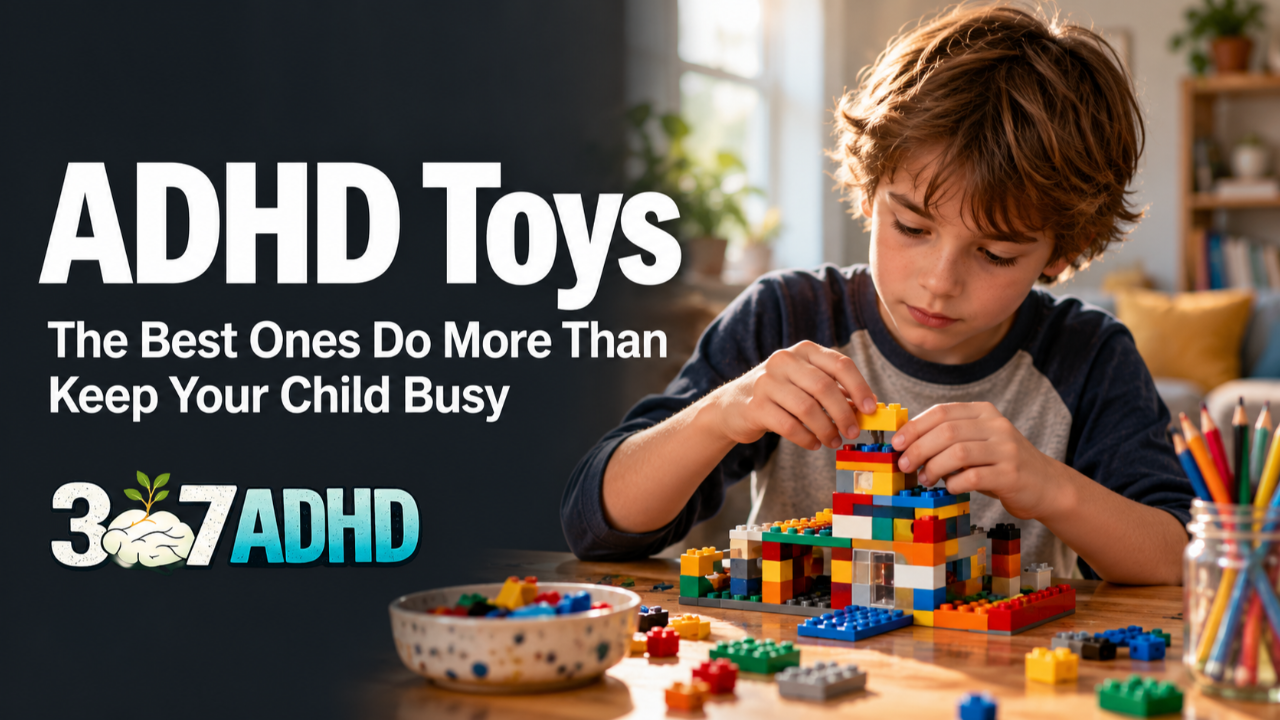
Search for “ADHD toys,” and you’ll find plenty of fidgets, sensory gadgets, and things to keep little hands busy.
Those can be useful. But when I think about toys for kids with ADHD, I’m looking for more than something that keeps them occupied for ten minutes.
I’m thinking about things they can build, change, explore, and come back to. Things that invite them to move their bodies, make decisions, try something that doesn’t work, and try again.
And sometimes, I’m thinking about a bag of ping-pong balls and some plastic cups.
Because the best play opportunities don’t have to be expensive or come with “ADHD-friendly” printed on the box. They need to give your child something interesting to do—and a reason to keep doing it.
ADHD Toys: What Makes a Toy Worth Coming Back To?
You know the toy your child desperately wanted? The one that made a noise, did its one impressive thing, and then spent the next six months under the couch?
Once they’ve figured out everything it does, there may not be much reason to return to it.
Compare that with a bin of building pieces. Today, it’s a garage. Tomorrow, it’s an obstacle course. Next week, it’s a very questionable invention that apparently requires every available piece of tape in your house.
The materials are familiar, but the possibilities keep changing.
The American Academy of Pediatrics highlights how traditional toys support imagination, problem-solving, interaction, and physical activity. You don’t need something labeled “ADHD-friendly” to offer valuable opportunities for play.
When choosing ADHD toys, ask:
-
Does this connect with something my child enjoys?
-
Can they use it in different ways?
-
Is there room to experiment or grow?
-
Is the challenge manageable with a little support?
-
Can they get started without me organizing an entire production?
No toy will stay interesting forever. But toys that let children contribute their own ideas offer more possibilities than toys that do all the entertaining for them.
Room to Create: Open-Ended Play With ADHD Toys
Some of the most valuable play opportunities give children room to decide what happens next.
Drawing. Painting. Clay. Building with loose LEGO bricks. Making a town for their Hot Wheels. Creating an elaborate storyline with Barbies.
There’s no single correct result.
That matters.
In coaching, I meet adults who struggle to get started when directions are vague. They want to know exactly what’s expected because they’re worried about getting it wrong. Making a choice can feel surprisingly uncomfortable when you’re used to looking for the one right answer.
Creative play gives children opportunities to practice choosing for themselves in a setting where the stakes are low.
What do I want to make? Which color do I like? What could I try?
The American Academy of Pediatrics explains that play supports children’s development and their relationships with others. Simple materials can give children plenty of room to explore their own ideas.
That doesn’t mean every child will immediately love a blank sheet of paper. Some will ask, “But what am I supposed to draw?”
You can give them a starting point without deciding the whole thing.
“Want to invent an animal?”
“Could we build a house for this dinosaur?”
Then let their idea become their idea.
The dinosaur’s house might have no door and fourteen swimming pools. You don’t need to fix that.
Good options include art supplies, open-ended craft materials, magnetic tiles, dress-up clothes, dolls, connecting car tracks, and cardboard boxes.
With art kits, look at how much freedom they allow. A kit that requires copying a precise example offers a different experience from materials a child can explore however they like. There’s room for both, but children also need opportunities where their version is enough.
Building Toys for ADHD: A Reason to Keep Trying
Other activities have a clear goal.
A LEGO set with instructions. An engineering kit. A puzzle. A model. A marble run that needs to actually deliver the marble to the bottom.
These give children opportunities to work through a sequence and figure out what happened when something doesn’t work.
The tower falls. A piece won’t fit. They realize they skipped a step.
Now there’s a problem to solve—and, ideally, something they care enough about to work toward.
That’s the sweet spot: a little bit hard, with an outcome they want.
We don’t need to make play frustrating on purpose. We want a challenge that fits the child, with support available when they need it.
Before taking over, try asking:
“Which part stopped working?”
“Want me to help you find the next step?”
“Do you want a hand, or a minute?”
Sometimes they need help. Sometimes they need a break. Sometimes they need us to stop touching the thing they are trying to build.
Cooking belongs in this category, too, even though it doesn’t come from the toy aisle.
A simple recipe gives children steps to follow, a finish to work toward, and something they get to enjoy afterward. Start with a recipe that fits their ability and your available patience. Making toast or assembling a snack can be a perfectly good starting point.
These experiences offer practice with persistence and problem-solving. That won’t automatically make homework easy, but it gives you a real experience to refer back to:
“Remember when your marble run kept collapsing and you figured out how to support it?”
They’ve experienced working through something difficult. You can help them notice that.
Movement Toys: Make Moving Easy to Do
Children need opportunities to move throughout the day. For many children with ADHD, movement can also be a useful part of settling, resetting, or managing their energy.
That’s worth considering when you set up your home.
Where can your child safely climb, roll, stretch, push, pull, balance, or swing?
Depending on their age, your space, and the supervision needed, possibilities might include:
-
Tumbling mats.
-
Balls and outdoor games.
-
Scooters or bikes.
-
An obstacle course.
-
Properly installed climbing or swinging equipment.
-
A designated space for dancing, stretching, or rolling around.
You don’t need all of these. You need options that work for your family.
Make suitable activities accessible, with clear safety boundaries established ahead of time. The goal is for some movement to happen without your having to suggest it, negotiate it, and supervise every detail.
Activities that require supervision still require supervision. But a safe place to stretch or a basket of outdoor balls can be ready to use.
And access to everyday movement doesn’t need to depend on having had a perfect day.
You can also offer movement as a redirect when things are getting tense:
“You seem like you need to move. Want to head outside with me?”
That feels different from being sent away because you’re in trouble.
Pay attention to what actually helps your child. One activity might help them settle; another might get them more wound up. You’re learning what works for their body and your household.
Engaging Books Count, Too
Books might not technically be toys, but they belong in this conversation.
Sometimes we spend so much energy trying to get children to read that we overlook the question: Have we found something they want to read?
The Who Would Win? books helped my son engage with reading in first grade. Comparing animals and discovering which one would win gave him a reason to keep going.
For another child, that might be graphic novels, comics, joke books, or a book packed with facts about their current obsession.
Graphic novels count as reading. So do books you wouldn’t personally choose.
An engaging format can make a challenging activity more inviting. Pictures, humor, shorter sections, and an interesting question can give a child a way in.
If reading continues to be difficult, they may also need specific reading support. Finding enjoyable books can be part of that support.
The goal is to help them discover something worth opening the book for.
Teens Still Need Play That Isn’t Their Phone
We don’t stop needing fun when we become teenagers.
But sometimes we stop providing obvious opportunities for it. The toys disappear, schedules fill up, and the phone becomes the easiest available source of entertainment.
Teens still need chances to move, make things, laugh, and do something ridiculous with people they like.
You might call it a challenge instead of play. That’s fine.
One of my favorite inexpensive options is ping-pong balls and cups.
Can you bounce the ball into the cup? Can you do it from farther away? Can you invent a shot nobody else can make?
Or grab a balloon and see how long you can keep it from touching the floor.
Who can do the moonwalk? Who can teach someone else? Who can invent the most ridiculous dance move?
These activities are simple, but there’s a lot to enjoy: a clear challenge, quick attempts, room to improve, and something funny happening right in front of you.
Other teens might enjoy building models, drawing, cooking, shooting baskets, making music, or learning a physical skill.
Start with their interests. Invite them in. Let them change the rules or invent the next challenge.
And if they don’t want to participate immediately, you can still start having fun. An invitation is easier to accept when it doesn’t come with a lecture about how much time they spend on their phone.
Games You Enjoy Together Build More Than Skills
Board games and card games offer opportunities to practice counting, taking turns, teamwork, patience, and handling disappointment.
They also give you a chance to enjoy your child.
Choose something you genuinely like. If you dread the game before the box is open, find another one.
Short games can be a great starting point. Cooperative games can work well, too. And sometimes the best option is the silly challenge you invented with things already in the kitchen.
While you play, notice what your child is doing well.
“You were disappointed, and you still congratulated your sister. That was kind.”
“You waited while I finished my turn. That took patience.”
“You tried a different way when the first one didn’t work. That was resourceful.”
The CDC recommends being specific when praising your teen. Naming what you noticed helps them understand exactly what you appreciate.
Those observations also give children something specific to recognize about themselves.
A child who hears a lot about being careless or difficult needs opportunities to see themselves as patient, responsible, creative, and a good teammate.
Keep it honest. They don’t need exaggerated praise for every move. They need us to notice real moments that might otherwise pass without comment.
And if losing is still hard, we can support them through that. A big feeling doesn’t erase everything they’re learning.
Where Do Screens Fit?
Screens can be fun. Video games can involve creativity, problem-solving, persistence, and connection.
The question is how much room remains for everything else.
Some digital entertainment offers fast, frequent rewards and constant novelty. A box of crayons or an unfinished puzzle may feel less immediately appealing beside it.
That makes it worth creating predictable screen boundaries while also making other activities easy to access.
A child is more likely to try something when the materials are visible, the setup is manageable, and someone is available to help them get started.
You can also give them time to become interested. A slower activity may not grab them in the first three seconds.
If you need help setting boundaries, the American Academy of Pediatrics offers a Family Media Plan to help you make decisions about how media fits into your family’s daily life.
Look at the overall balance: Are there regular opportunities to move, create, read, build, and spend time together?
That’s more useful than labeling every screen activity bad or expecting every minute away from a device to be productive.
Start With One Opportunity
You don’t need to buy a whole collection of ADHD toys or turn your living room into an activity center.
Start with something your child already enjoys.
Put the drawing supplies where they can reach them. Leave space for an unfinished building project. Find a book about their favorite subject. Set out cups and ping-pong balls and challenge them to beat your shot.
Then watch what happens.
Do they need an easier starting point? A little help? More freedom? Someone to join them?
Play gives you a chance to learn about your child while they learn about themselves.
And sometimes, it gives your whole family ten minutes of laughing together instead of arguing about what to do next.
Want Help Making Daily Life Work Better for Your ADHD Family?
Knowing your child needs support is one thing. Figuring out what that looks like in your home can be harder—especially when you’re already tired of reminding, redirecting, and managing everything.
Need Ideas That Fit Your Energy Today?
You don’t need an elaborate activity to have fun with your family. But you do need ideas that fit the energy you actually have.
My free Connection & Play Menu includes cheap or free ways to connect, organized by parent capacity—from ready to get moving to very little left in the tank. Because your energy matters, too.
Get your free Connection & Play Menu
In my parent and family coaching, we use my Surface → Source → Shift™ approach to look beneath the daily struggles and find practical ways forward.
That might mean changing the environment, adjusting an expectation, building a skill, or finding more opportunities for connection.
We work together to create an approach that fits your child and your family.
Book a discovery call to talk about where you’re getting stuck and how coaching could help.

Rebecca Kuhbacher, M.Ed., is an ADHD and Executive Function Coach, former teacher, and mom of four in an ADHD household. She helps parents look beneath daily struggles, build practical skills, and create more opportunities for connection and fun.
FAQ's ADHD Toys
1. What are the best ADHD toys for kids and teens?
The best ADHD toys connect with your child’s interests and give them something to do, explore, or figure out. Think building sets, art supplies, pretend-play materials, movement toys, and games you enjoy together. For teens, that might be cooking, model building, or a ridiculous ping-pong ball challenge. Look for possibilities they can return to in different ways. You don’t need an “ADHD-friendly” label or a huge budget.
2. Do fidget and sensory toys help kids with ADHD focus?
Some children find that a fidget gives their hands something to do while they listen. Others end up more interested in the fidget than the activity. Notice what happens for your child: Can they follow the conversation or directions more easily while using it? Keep the tool if it helps, and adjust if it becomes a distraction. Fidgets can be useful, but they’re only one option.
3. What are good quiet ADHD toys for school or homework?
Soft putty, a squeeze ball, or a quiet, handheld fidget may work, depending on your child and the setting. Choose something simple enough that it doesn’t require their eyes or become its own project. Ask your child what helps, and coordinate with their teacher for classroom use. The goal is to make participating easier.
4. What movement toys help kids with ADHD manage restless energy?
Balls, scooters, small trampolines, tumbling mats, obstacle courses, and safely installed climbing or swinging equipment offer ways to move. What works will depend on your child, your space, and the supervision needed. Make safe movement options part of everyday life rather than something they have to earn. You can also offer movement before frustration builds: “Want to go shoot baskets for a few minutes?” Notice which activities help your child feel more settled.
5. Are LEGO sets and building toys good for kids with ADHD?
They can offer fantastic opportunities to create and solve problems. Following LEGO instructions gives a child a specific goal and steps to work through. Building from a bin of loose pieces gives them room to make their own decisions. Both have value. Choose a manageable challenge, and offer enough help to keep them moving without automatically taking over.
6. What toys help children with ADHD practice patience, persistence, and problem-solving?
Puzzles, building sets, marble runs, engineering kits, and board games all offer opportunities to practice. Cooking does, too. Look for something a little challenging that your child actually wants to do. When they get stuck, help them identify the next step or take a break. We’re giving them a supported chance to experience, “That didn’t work. What else could I try?”
7. How do I choose ADHD toys my child won’t quickly get bored with?
Start with what interests your child, then look for room to change or expand the activity. Connecting tracks, art supplies, dolls, and building materials can become something different each time. No toy will stay interesting forever, and more features don’t necessarily mean more lasting interest. Sometimes putting a few things away and bringing them back later makes familiar materials inviting again.
8. What creative activities can kids with ADHD do instead of screen time?
Try drawing, painting, clay, making music, building a cardboard town, or inventing a story with dolls or action figures. Give them opportunities where there isn’t one right answer. If getting started feels hard, offer a small prompt: “Could you invent an animal?” Then let them decide what happens next. You can also make reading more inviting with graphic novels, comics, or books about something they already love.
9. What are cheap or free family activities for kids with ADHD, especially when parents have low energy?
Ping-pong balls and cups are one of my favorites. Try bouncing the ball into a cup, inventing a trick shot, or challenging each other to beat a record. Keep a balloon off the floor, play cards, or see who can do the moonwalk. You can participate from the couch if that’s what your energy allows. My free Connection & Play Menu organizes inexpensive ideas by parent capacity, because your energy matters, too.
10. Where can I find ADHD toys and sensory tools that fit my child’s needs?
Start with what you already have, then check toy stores, secondhand shops, libraries with lending collections, or online retailers. Specialty sensory stores can be useful when you’re looking for a particular tool, but you don’t need to start there. Ask what you’re hoping to offer: movement, creativity, a manageable challenge, or time together. That gives you a better starting point than buying whatever appears on an “ADHD must-haves” list.
Hey!